
Fragmented ERP, CIS, and SCADA environments continue to limit how utilities access, share, and operationalize data. Disconnected systems create delays in decision-making, increase reconciliation effort, and constrain the effectiveness of AI initiatives. As a result, many organizations struggle to move beyond isolated pilots into enterprise-scale deployment.
A unified data foundation changes this dynamic. By enabling consistent, governed access to operational and financial data, utilities can deploy AI capabilities incrementally without restructuring core systems. This approach aligns modernization with measurable outcomes rather than long, uncertain transformation programs.
Here are the core capabilities that define a utility data fabric AI approach:
- Unified data access across systems
- Real-time data orchestration
- Governed data models and lineage
- Interoperability across domains
- Embedded AI enablement within workflows
Utility data fabric AI is an architectural approach that unifies and governs data across enterprise systems in real time, enabling interoperability between ERP, CIS, SCADA, and operational platforms while supporting AI-driven decision-making directly within workflows through consistent, traceable, and accessible data structures.
In this blog post, you will understand how utility data fabric AI enables modular AI deployment, supports measurable outcomes across domains, and provides a structured path to scalable modernization.
What is utility data fabric AI
Utility data fabric AI establishes a governed, interoperable data layer that connects fragmented enterprise systems into a unified, real-time environment. Unlike traditional data integration approaches that rely on batch processing or static pipelines, this architecture enables continuous data orchestration across ERP, CIS, SCADA, and operational platforms. As a result, data becomes accessible, consistent, and actionable across domains.
This approach differs from data lakes, which centralize raw data without enforcing operational context, and from point-to-point integrations that increase complexity over time. Instead, utility data fabric AI organizes data through shared models, lineage tracking, and governance controls, ensuring that every dataset supports operational workflows and compliance requirements.
By aligning data architecture with enterprise processes, utility data fabric AI transforms data into a usable foundation for AI modules. This enables AI to operate within workflows rather than as isolated analytics tools, strengthening decision-making, improving visibility, and supporting measurable performance improvements across the organization.
How data fabric enables modular AI
A unified data foundation allows AI modules to operate independently while sharing consistent, governed data. This reduces dependency on system replacement and enables incremental deployment aligned with operational priorities.
Here are the core mechanisms that enable modular AI deployment:
Decoupled AI modules
Decoupled AI modules operate independently of core transactional systems while accessing shared data through the utility data fabric AI layer. This separation allows utilities to deploy targeted capabilities without disrupting ERP or CIS environments, reducing implementation risk and accelerating adoption while maintaining alignment with existing operational workflows and system dependencies.
Shared data foundation
A shared data foundation ensures that all AI modules access consistent, governed datasets across domains. By standardizing data models and definitions, utility data fabric AI eliminates discrepancies between systems, enabling reliable analytics and automation. This consistency supports cross-functional alignment and ensures that decisions are based on unified, traceable data rather than fragmented or conflicting information.
Rapid deployment cycles
Standardized data access reduces the time required to integrate and deploy new AI modules. Instead of building custom integrations for each use case, utilities can leverage existing data connections within the utility data fabric AI architecture. This approach shortens deployment timelines, enabling modules to be implemented in weeks and validated through measurable outcomes within operational cycles.
Cross-module intelligence
Cross-module intelligence emerges when multiple AI modules operate on the same data foundation. Insights generated in one domain can inform decisions in another, creating a coordinated system of intelligence. For example, operational data can influence customer communication strategies, while financial insights can refine asset planning decisions, improving overall enterprise performance.
Scalable deployment model
A scalable deployment model allows utilities to expand AI adoption incrementally based on validated results. Starting with a single high-impact use case, organizations can extend capabilities across domains without reconfiguring underlying systems. Utility data fabric AI supports this progression by maintaining consistent data access and governance across all modules..
Integration with legacy systems
Integration with legacy systems remains critical for operational continuity. Utility data fabric AI enables interoperability without requiring system replacement, connecting ERP, CIS, and SCADA platforms through standardized interfaces. This approach preserves existing investments while enabling modernization, ensuring that AI deployment aligns with infrastructure constraints and regulatory requirements.
Where data fabric drives utility outcomes
A unified data layer enables measurable improvements across core utility domains by aligning data access with operational and strategic workflows. These outcomes demonstrate how utility data fabric AI translates infrastructure into performance gains.
Operations performance improvement
Operations performance improves when real-time data from grid, field, and asset systems becomes accessible through a unified layer. Utility data fabric AI enables predictive maintenance, faster outage detection, and optimized crew dispatch by integrating telemetry and operational data, reducing downtime and improving reliability metrics across infrastructure and service delivery environments.
Customer service optimization
Customer service optimization benefits from unified visibility across billing, service interactions, and outage events. Utility data fabric AI enables proactive communication, reduces call volumes, and improves first-contact resolution by providing consistent customer context, leading to measurable reductions in service costs and improved satisfaction outcomes across channels.
Digital transformation acceleration
Digital transformation accelerates when data is consistently available across systems and domains. Utility data fabric AI reduces integration barriers, enabling faster deployment of new capabilities and supporting experimentation with lower risk. This approach shortens transformation timelines while maintaining alignment with governance and operational requirements.
Financial accuracy gains
Financial accuracy improves through consistent data reconciliation across billing, revenue, and operational systems. Utility data fabric AI enables early detection of anomalies, reduces manual adjustments, and strengthens forecasting accuracy, resulting in improved revenue assurance and more reliable financial reporting aligned with regulatory expectations.
Compliance reporting efficiency
Compliance reporting efficiency increases when data lineage and traceability are embedded within the data architecture. Utility data fabric AI supports automated reporting workflows, reduces preparation time, and improves accuracy by ensuring that all regulatory data is consistent, auditable, and aligned across systems.
Corporate strategy alignment
Corporate strategy alignment strengthens when decision-makers have access to consistent, enterprise-wide data. Utility data fabric AI enables visibility into operational and financial performance, supporting more accurate planning, prioritization of initiatives, and alignment between strategic objectives and measurable outcomes across the organization.
Technology architecture optimization
Technology architecture optimization occurs when systems operate within a unified data framework. Utility data fabric AI reduces integration complexity, improves interoperability, and enhances system observability, enabling more efficient management of infrastructure while supporting scalable innovation across the enterprise technology stack.
What risks must data fabric address
Utility data fabric AI introduces new capabilities while requiring disciplined governance to manage risks associated with data integrity, compliance, and system integration. These constraints must be addressed to ensure sustainable deployment.
Data governance requirements
Data governance requirements ensure that data access, usage, and ownership are clearly defined across the organization. Utility data fabric AI must enforce policies that maintain data consistency, protect sensitive information, and support compliance with regulatory standards while enabling controlled access for operational and analytical use cases.
Integration complexity risks
Integration complexity risks arise when connecting multiple legacy systems with varying data structures and interfaces. Utility data fabric AI must standardize integration patterns and reduce dependencies to prevent increased system fragility, ensuring that modernization efforts do not introduce operational disruptions or additional maintenance burden.
Compliance and auditability
Compliance and auditability depend on traceable data flows and consistent reporting structures. Utility data fabric AI must maintain detailed lineage and documentation, enabling organizations to demonstrate regulatory compliance, support audits, and ensure that all reported data is accurate and verifiable across systems.
Data quality management
Data quality management remains critical for reliable AI outcomes. Utility data fabric AI must implement validation processes, monitoring mechanisms, and standardized definitions to ensure that data remains accurate, complete, and consistent, preventing errors that could impact decision-making or regulatory reporting.
How to implement data fabric architecture
Implementing utility data fabric AI requires a structured approach that aligns technical execution with measurable outcomes. The following phased model provides a practical path from fragmented systems to modular AI deployment readiness.
Assess data landscape
Assessing the data landscape involves identifying existing systems, data flows, and integration points across the enterprise. This phase establishes a baseline for data availability, quality, and accessibility, enabling organizations to prioritize areas where unified data access can deliver immediate operational or financial impact.
Define data models
Defining data models standardizes how data is structured, interpreted, and shared across systems. Utility data fabric AI relies on consistent definitions and relationships to ensure interoperability, enabling reliable analytics and automation across domains while reducing ambiguity and inconsistencies in data usage.
Integrate core systems
Integrating core systems connects ERP, CIS, SCADA, and other operational platforms through the data fabric layer. This phase focuses on establishing real-time data flows and ensuring that data can be accessed and utilized across domains without disrupting existing workflows or system performance.
Enable AI modules
Enabling AI modules builds on the unified data foundation by deploying targeted capabilities aligned with specific use cases. Utility data fabric AI supports rapid deployment by providing standardized data access, allowing modules to operate effectively and deliver measurable outcomes within defined operational cycles.
Scale across domains
Scaling across domains extends AI capabilities beyond initial use cases, leveraging the shared data foundation to expand deployment across operations, customer service, finance, and compliance. This phase ensures that modernization progresses incrementally, with each expansion validated through performance improvements and ROI metrics.
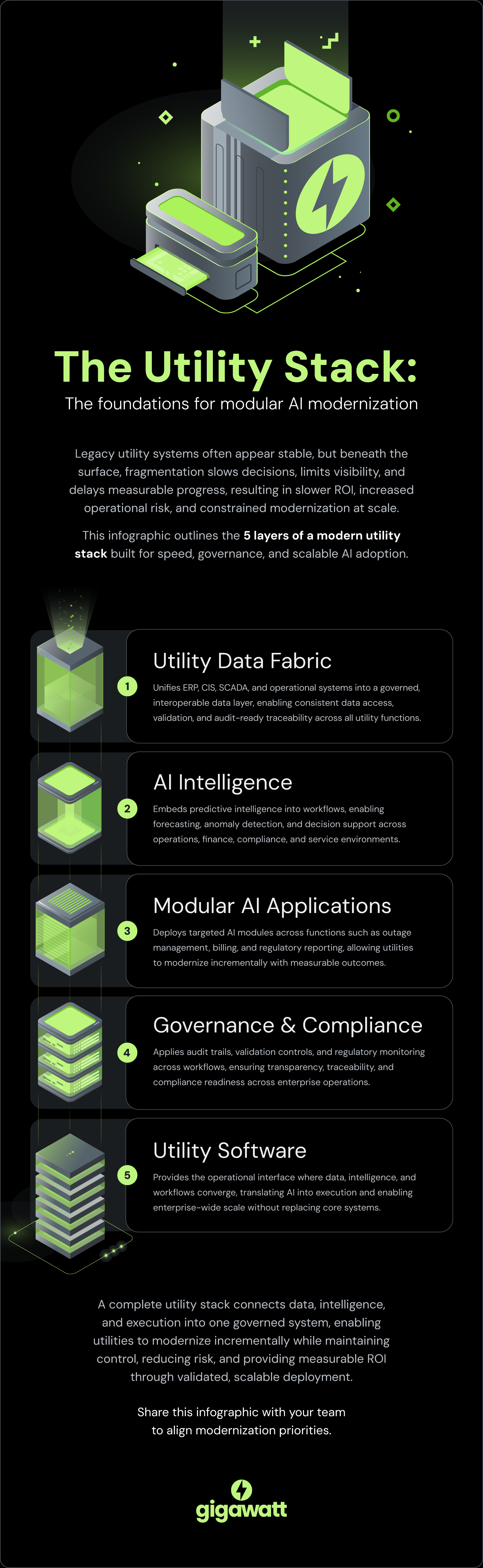
How utility software enables AI adoption
Utility software operationalizes the data fabric and AI modules by embedding intelligence directly into workflows. These capabilities ensure that data-driven insights translate into measurable actions across the enterprise.
Here are the key enablers of adoption:
Workflow integration layer
Workflow integration ensures that AI insights are delivered within existing operational processes. Utility software connects data fabric outputs with daily workflows, enabling teams to act on insights without switching systems, improving efficiency and reducing friction in decision-making.
Application-level intelligence
Application-level intelligence embeds AI capabilities within specific use cases, such as outage management or billing validation. Utility software translates data into actionable recommendations, ensuring that insights are directly applied to operational tasks and contribute to measurable performance improvements.
User adoption drivers
User adoption depends on usability, relevance, and alignment with existing workflows. Utility software must present insights in a clear, actionable format, enabling users to trust and adopt AI-driven recommendations while maintaining control over decision-making processes.
System interoperability
System interoperability ensures that utility software integrates seamlessly with existing platforms. By leveraging the data fabric layer, applications can operate across ERP, CIS, and operational systems, reducing duplication and enabling consistent data usage across all workflows.
Performance monitoring capabilities
Performance monitoring capabilities track the impact of AI modules and data fabric deployment. Utility software provides visibility into KPIs, enabling organizations to measure improvements in reliability, cost, and service performance, supporting continuous optimization and informed decision-making.
Governance and control mechanisms
Governance and control mechanisms ensure that AI-driven processes remain compliant and auditable. Utility software enforces data access policies, tracks usage, and maintains documentation, supporting regulatory requirements while enabling scalable adoption across the enterprise.
How data fabric shapes utility modernization
Utility data fabric AI establishes a foundation for scalable modernization by aligning data architecture with incremental deployment strategies. Rather than pursuing large-scale system replacements, utilities can adopt a phased approach that delivers measurable outcomes at each stage, reducing risk and improving capital efficiency.
As AI modules are deployed and validated, the shared data foundation enables continuous expansion across domains. This compounding effect transforms isolated improvements into enterprise-wide capabilities, strengthening operational performance, financial accuracy, and compliance outcomes over time.
Looking forward, utility data fabric AI supports a transition toward an AI operating system model, where data, intelligence, and workflows operate as an integrated environment. This approach ensures that modernization remains aligned with evolving business requirements, regulatory expectations, and technological advancements, enabling sustained progress without disruption.
Why utility data fabric AI drives scalable modernization
Utility data fabric AI enables modular AI deployment by transforming fragmented data into a unified, governed foundation for decision-making. This alignment between infrastructure and outcomes ensures that AI operates within workflows, delivering measurable improvements in reliability, cost efficiency, and compliance.
A phased, controlled approach allows organizations to validate results before scaling, reducing risk while maintaining operational continuity. By starting with a single capability and expanding incrementally, utilities can achieve modernization that aligns with real-world constraints and measurable performance goals.
As modernization continues, utility data fabric AI will remain central to enabling interoperability, supporting governance, and ensuring that AI deployment scales effectively across domains. This foundation positions utilities to sustain long-term transformation while maintaining control over systems, data, and outcomes.
Now that you know how modular AI utilities architectures improve performance and interoperability across enterprise systems, read The new economics of utility data ownership in digital transformation blog post to explore how utility data fabric AI strengthens data ownership, governance, and scalable AI outcomes across systems.