
Utilities face increasing pressure to modernize operations while maintaining stability across critical systems. However, replacing ERP, CIS, or SCADA platforms introduces cost, risk, and long deployment timelines that often delay measurable outcomes.
As a result, AI integration approaches in utilities are shifting toward approaches that layer intelligence over existing infrastructure. This enables faster deployment, controlled risk, and improved coordination without disrupting core operations.
Here are the key principles of AI integration in utilities:
- Layer AI across existing systems
- Connect data through a unified fabric
- Embed intelligence into workflows
- Validate outcomes before scaling
- Maintain governance and traceability
This approach transforms fragmented systems into coordinated environments where data flows continuously and decisions improve across domains.
In this blog post, you will understand how utilities integrate AI without replacing core systems, including architecture models, integration constraints, and scalable deployment strategies.
What defines AI integration across utility systems
AI deployment strategies across utilities begin by redefining how intelligence operates across existing infrastructure. Rather than embedding AI inside individual systems or replacing them entirely, integration positions AI as a horizontal decision layer that connects ERP, CIS, and SCADA environments. This model improves coordination, reduces latency, and enables consistent decision-making across fragmented workflows, establishing a measurable scope for visibility, automation, and performance improvement.
System integration layers
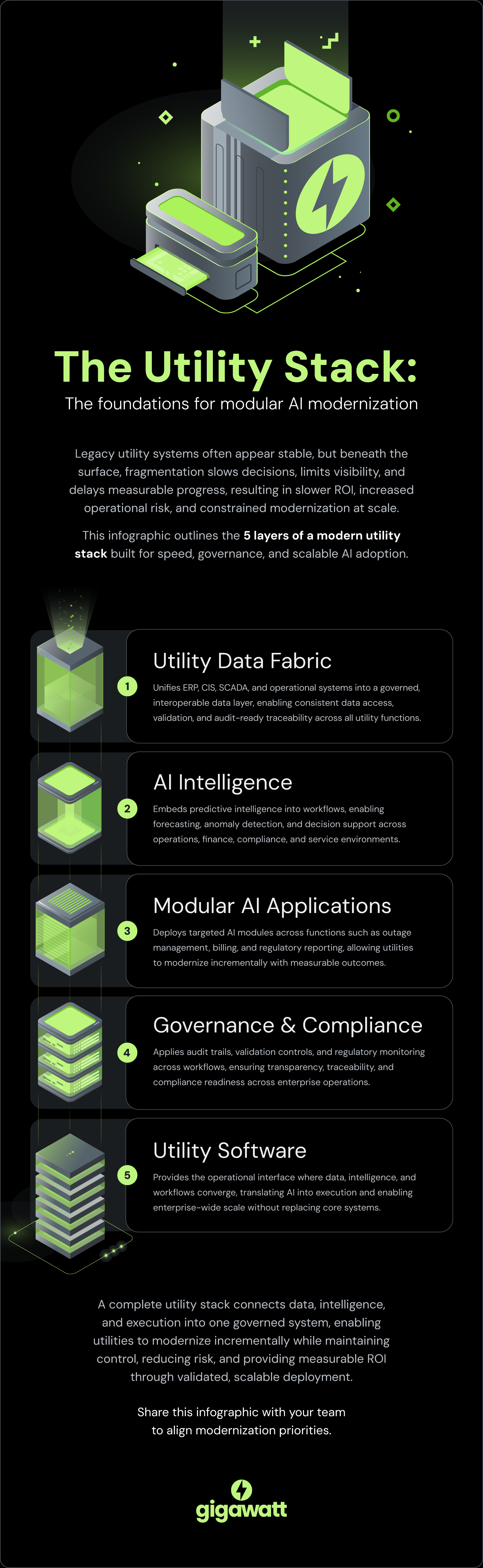
AI integration in utilities operates across three layers: data ingestion, intelligence processing, and application interaction. These layers connect legacy systems without disrupting them, enabling coordinated insights across operations. By separating intelligence from core systems, utilities maintain system stability while improving performance. This layered model ensures interoperability and reduces integration risk across enterprise environments.
Data fabric role
Utility Data Fabric enables utility AI integration models by unifying data across ERP, CIS, and SCADA systems. It standardizes data models, ensures governance, and enables real-time access across domains. This foundation eliminates silos and supports consistent analytics and automation. With governed data connectivity, utilities can deploy AI modules that operate across systems while maintaining compliance and traceability.
Workflow embedding model
AI integration becomes effective when intelligence is embedded into operational workflows rather than isolated dashboards. This model ensures insights directly influence decisions across operations, service, and finance. By integrating AI into daily processes, utilities reduce manual effort and improve response times. Workflow embedding aligns AI outputs with measurable actions, strengthening operational outcomes and decision accountability.
Why legacy systems limit AI integration
Legacy systems constrain AI integration in utilities initiatives due to fragmented architectures and isolated data environments. ERP, CIS, and SCADA systems were designed for functional stability, not cross-domain intelligence. As a result, data remains siloed, workflows disconnected, and decision-making delayed. These limitations prevent utilities from achieving real-time visibility and coordinated operations across enterprise systems.
Fragmentation directly impacts operational performance. Data inconsistencies require manual reconciliation, increasing processing time and error rates. Disconnected workflows delay response times in critical scenarios such as outages or billing anomalies. These inefficiencies reduce reliability, increase operational costs, and limit the ability to scale modernization efforts.
The financial impact becomes evident in delayed ROI. Multi-year transformation programs struggle to deliver measurable outcomes due to integration complexity. Without unified data and coordinated workflows, AI in utility systems cannot operate effectively. Addressing these constraints requires an integration-first approach that preserves existing systems while enabling enterprise-wide intelligence.
What is the strategic value of AI integration
AI deployment strategies across utilities create measurable value by aligning intelligence with operational outcomes. Instead of focusing on deployment scale, utilities prioritize performance improvements across reliability, cost efficiency, and service quality. Integration enables consistent decision-making across systems, reducing latency and improving coordination.
The strategic value becomes visible through capital efficiency. Modular AI deployment allows utilities to validate outcomes within existing investment cycles. Rather than committing to large transformation programs, utilities deploy targeted capabilities that deliver measurable ROI within months. This approach reduces financial risk while accelerating modernization progress.
Integration also strengthens enterprise visibility. By connecting data across domains, utilities gain a unified view of operations, customer interactions, and financial performance. This visibility supports better planning, faster response times, and improved compliance. Utility data integration AI strategies therefore transform fragmented systems into coordinated decision infrastructure that drives measurable outcomes.
How utilities integrate AI across utility domains
AI integration in utilities strategies reach full value when intelligence connects domains rather than operating in isolation. Integration aligns operations, customer systems, financial processes, and compliance workflows through shared data and coordinated execution. As a result, events propagate across systems in real time, improving responsiveness and consistency. Enterprise-wide visibility emerges from this structure, enabling utilities to track performance across interconnected KPIs such as reliability, cost-to-serve, and revenue assurance.
These are the primary ways utilities integrate AI across domains:
Integrate operational data intelligence
AI connects grid, asset, and field data into unified intelligence models that improve reliability and reduce downtime. Predictive insights identify risks before failure occurs, enabling proactive intervention. This integration reduces outage duration and maintenance costs. By aligning operational systems through shared data, utilities improve situational awareness and accelerate coordinated decision-making across infrastructure environments.
Integrate customer and outage intelligence
Customer platforms integrate with outage and operational systems to deliver proactive communication and faster issue resolution. AI correlates service interruptions with customer data, improving transparency and response accuracy. This integration reduces inbound inquiries and enhances customer experience. By linking service and operations, utilities align communication workflows with real-time grid conditions and service events.
Integrate billing and revenue intelligence
Billing systems integrate with operational and customer data to detect anomalies and improve revenue accuracy. AI identifies discrepancies across usage, billing, and payment patterns, reducing revenue leakage. This integration strengthens financial visibility and control. By connecting billing workflows with operational events, utilities ensure that revenue processes reflect actual service delivery and consumption patterns.
Integrate financial and operational planning
Financial systems integrate with operational data to improve forecasting, budgeting, and capital allocation decisions. AI models correlate operational performance with financial outcomes, enabling more accurate planning. This integration supports cost optimization and investment prioritization. By aligning financial and operational data, utilities improve decision accuracy and strengthen long-term planning discipline.
Integrate compliance and reporting intelligence
Compliance processes integrate with enterprise data to ensure accurate reporting and audit readiness. AI monitors regulatory thresholds and identifies deviations across workflows. This integration reduces manual reporting effort and improves traceability. By linking compliance systems with operational and financial data, utilities maintain transparency and reduce regulatory risk across reporting cycles.
Integrate workforce and asset coordination
Workforce systems integrate with asset and operational data to optimize scheduling and field execution. AI aligns resource allocation with asset conditions and service priorities, improving efficiency. This integration reduces delays and enhances safety outcomes. By coordinating workforce activities with real-time intelligence, utilities improve execution consistency across field operations.
Integrate cross-domain decision intelligence
AI integrates insights from all domains to enable enterprise-wide decision-making based on unified data. Correlation across systems provides a comprehensive view of performance, risks, and opportunities. This integration improves coordination and strategic alignment. Utilities benefit from consistent, data-driven decisions that connect operational execution with financial and customer outcomes.
How to align integration with utility software
AI adoption approaches in utilities must align with the existing utility software stack to ensure interoperability and scalability. Instead of replacing systems, AI operates as a coordination layer across application, data, and workflow components. This alignment ensures that intelligence enhances existing capabilities while preserving system stability. Following this structure clarifies how integration operates across software layers.
Application layer alignment
AI modules integrate with existing applications such as ERP and CIS to enhance functionality without disruption. This alignment allows utilities to extend system capabilities while maintaining core operations. By operating externally, AI avoids complex system modifications. Application-level integration ensures faster deployment and reduces risk across enterprise environments.
Data layer integration
Data integration connects multiple systems through a unified Utility Data Fabric, enabling consistent access and governance. This layer ensures data quality, traceability, and interoperability across domains. By standardizing data models, utilities improve analytics and automation capabilities. Data layer integration is essential for enabling scalable AI in utility systems.
Workflow layer coordination
Workflow integration embeds AI insights directly into operational processes, ensuring decisions are executed efficiently. This coordination reduces manual intervention and improves response times. By aligning workflows across systems, utilities achieve consistent execution of tasks. Workflow-level integration ensures that AI-driven insights translate into measurable operational outcomes.
Advance AI integration in utilities for scalable modernization
Enterprise AI integration models for utilities redefine modernization by focusing on coordination rather than replacement. Utilities achieve measurable outcomes by layering AI across existing systems, enabling faster deployment and reduced risk.
Integration improves visibility, connects workflows, and strengthens decision-making across domains. By aligning AI with utility software layers, organizations preserve system stability while enhancing performance. Modular deployment ensures that each step delivers validated value before expansion.
As utilities scale integration, the focus shifts from isolated improvements to enterprise-wide intelligence. This progression supports long-term modernization aligned with operational constraints and regulatory requirements. AI integration in utilities approaches therefore establishes a foundation for continuous improvement and measurable transformation.
Want to see how integration, not replacement, drives modernization outcomes? Read the Why utilities need an operating system beyond ERP and CIS blog post to understand how a unified operating layer connects systems, data, and workflows across the enterprise.