
An AI deployment approval leaves an important question unresolved: what happens when the approved capability meets a situation its reviewers did not anticipate? Source data arrives late, or a downstream system returns a response no one planned for. The utility still needs someone responsible for deciding whether the workflow can proceed.
That responsibility extends beyond the model. It includes the objective the utility approved, the data AI can access, the recommendations it can generate, the actions employees can authorize, and the evidence retained after execution. A policy becomes useful when those requirements appear in the work itself.
For regulated operations, the practical test is whether the utility can follow an AI-assisted decision from its starting point to its disposition. The utility AI governance chain provides a way to examine those connections, including the handoffs where responsibility can become unclear.
What does AI governance mean for utilities?
AI governance defines the responsibilities, controls, and evidence that guide the development, deployment, use, and ongoing review of AI capabilities. In a utility, its scope follows the operating consequences of those capabilities. A tool drafting an internal summary and a workflow proposing customer account adjustments require different oversight.
AI governance and data governance
Data governance establishes ownership, access, definitions, and handling requirements. AI governance extends that foundation to the use of data: what the AI capability may infer, recommend, or initiate, and under which conditions. Utilities need clear ownership and controls for data before evaluating how an AI-assisted workflow uses it.
Accountability across AI-assisted workflows
An AI recommendation should have a defined recipient and an explicit disposition. Someone must own review, exception handling, and correction when the output cannot support an acceptable action.
Utility obligations and operational consequences
Billing accuracy, customer privacy, service continuity, and financial controls shape deployment decisions. Governance should connect AI use to the obligations applicable to the workflow and jurisdiction.
Match AI controls to operational risk
The action AI supports determines the controls it needs. Access to the same customer data can support a draft explanation, an investigation recommendation, or an account update, each with different consequences.
Recommendations, approvals, and automated actions
Specify the AI role before selecting controls. Does it retrieve information, identify a potential discrepancy, recommend investigation, or initiate a permitted update? Approval of one role should never imply permission for another. An employee-facing recommendation can remain within a narrow deployment boundary even when broader automation is technically possible.
Customer, financial, and reliability consequences
Assess who could be affected, how broadly an error could spread, and how quickly it would be detected. A misleading billing explanation can create customer confusion; an incorrect adjustment can change a balance. The assessment should include the consequences of delay as well as incorrect action.
Reversibility and escalation requirements
Define which actions can be corrected, what correction requires, and when execution must stop. An uncertain output affecting a customer balance may need specialist review. A recommendation with insufficient source evidence should return for investigation instead of advancing simply because the workflow has an approval button.
The utility AI governance chain
The governance chain connects approved intent with the outcome of an AI-assisted workflow. Its control points help technology, operations, and governance teams examine the same deployment while keeping their different responsibilities in view.
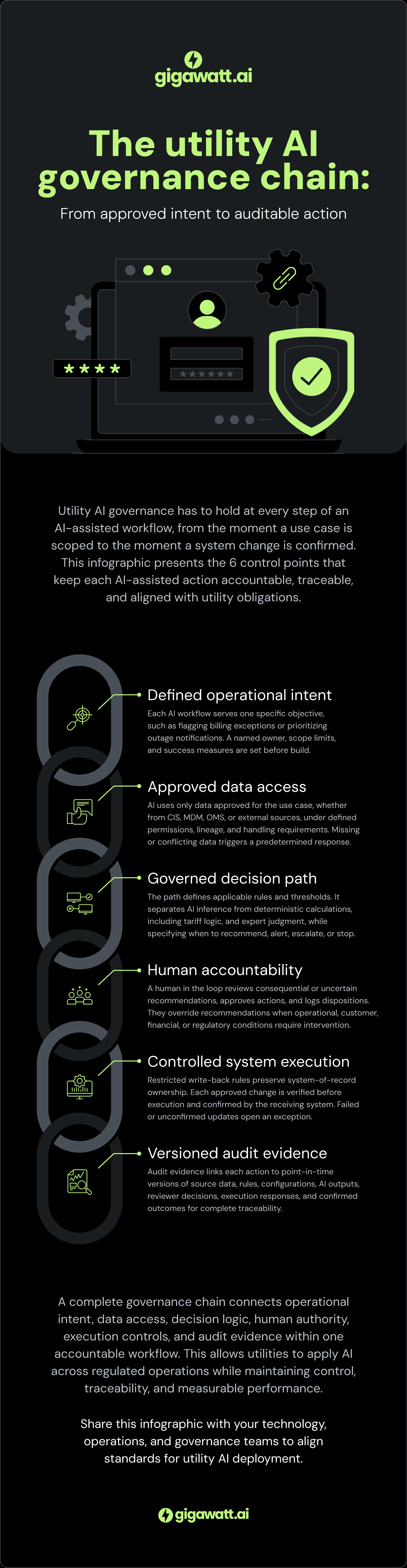
The chain is a practical review model. Utilities should adapt it to their own risk assessments, policies, and applicable obligations. Its value lies in examining the connections between controls, including what happens when a link fails.
Defined operational intent
Governance starts with a specific objective and a named business owner. “Improve billing operations” leaves too much open to interpretation. “Identify potential billing discrepancies for employee investigation” establishes a clearer role for AI and a more useful starting point for approval.
Document the intended users, permitted outputs, affected systems, and conditions excluded from scope. Agree on what success means before deployment. If the objective is to reduce investigation effort, the baseline should include the time employees currently spend reviewing exceptions and the quality of their dispositions.
Boundaries also need operational meaning. The capability might generate a recommendation and supporting references while leaving adjustment approval entirely with the billing team. Any proposal to add account updates would then require a separate assessment of permissions, validation, and consequences.
A concise use-case charter can capture these decisions. The important outcome is agreement about the work being authorized, including what the AI capability should do when the objective cannot be achieved within its boundaries.
Approved data access
Each source the capability uses should have a documented purpose. Approval should address the data’s suitability for the task as well as access permissions, because an authorized source can still contain outdated, incomplete, or conflicting information.
For billing investigation, relevant inputs might include billed usage, meter data, account attributes, and approved reference material. Access should reflect the employee’s role and the task being performed. A workflow investigating a discrepancy has no reason to acquire unrestricted access to unrelated customer information.
Source lineage helps reviewers understand where information originated and how it was transformed. Handling requirements should address retention, exposure in outputs, and access to supporting evidence. When a required source is unavailable, the workflow needs a defined response, never permission to substitute unapproved information.
Data owners should be able to identify which AI-assisted workflows depend on their sources. That connection makes changes to definitions, quality, or availability visible to the people responsible for deployment performance.
Governed decision path
This link defines how the capability moves from a question to an output. It identifies the information the capability should consider, the rules that apply, and the conditions that trigger a recommendation, task, alert, or escalation. AI inference should remain distinguishable from deterministic calculations and human judgment so reviewers can identify each contribution to the decision.
An AI model might identify an unusual billing pattern or summarize supporting data. Existing billing calculations and approved adjustment rules can remain within established utility processes. The workflow should make those different contributions visible so a plausible explanation cannot be mistaken for an authorized financial decision.
Specify how incomplete information and conflicting inputs affect the permitted response. Any confidence threshold used for routing needs validation for the actual task. A model’s expressed certainty, by itself, provides insufficient grounds for authorizing a consequential action.
Preserve the versions of relevant rules, configurations, and reference material. Reviewers need to understand the conditions under which the recommendation was produced. A generated explanation can assist review, but it should not be treated as a verified account of the model’s internal reasoning.
Human accountability
Review belongs with roles that have the knowledge, time, and approval rights the decision requires. “Human in the loop” becomes operationally useful only when the utility specifies who reviews what and what that person can change.
The reviewer should receive enough context to accept, reject, or return the recommendation for investigation. Supporting data, relevant rules, unresolved uncertainties, and the proposed action should be visible together. Approval should capture the reviewer’s actual decision, beyond confirming that an output was opened.
Define who owns low-confidence outputs and exceptions that fall outside the original workflow. A billing subject matter expert may need to resolve an interpretation question before an authorized approver considers an adjustment. Escalation should have an accountable recipient and a way to track unresolved work.
Employees also need a practical override route. When circumstances make a recommendation inappropriate, the workflow should allow intervention and preserve the reason. That evidence helps teams distinguish model issues from legitimate changes in operational conditions.
Controlled system execution
Permission to recommend an action differs from permission to update a system. Write-back rules should specify permitted changes, required approvals, validation checks, and the system responsible for the resulting data.
The utility can use controlled integration with existing systems to preserve CIS or ERP ownership while introducing an AI-assisted capability. The integration itself should enforce the approved scope, so compliance does not depend on employees remembering it.
Execution controls must address failure. If an update request times out, the workflow should determine whether the receiving system completed the change before attempting it again. A duplicate financial adjustment is a very different problem from a recommendation that never advanced to approval.
Confirm the final system state and route ambiguous results for investigation. Where recovery is possible, define who can authorize it and how corrections are documented. A transmitted request shows that an attempt was made; completion requires confirmation from the authoritative system.
Audit and performance evidence
Retain evidence that connects the inputs, recommendation, approval, action, and outcome. The appropriate detail depends on the workflow, but the relationship between those events should remain clear.
Useful evidence can include source references, relevant data versions or timestamps, the configuration used, the AI output, the reviewer’s decision, the execution response, and the confirmed system change. Preserve rejected recommendations and unresolved exceptions as well as completed actions.
Evidence capture should support review of AI-assisted decisions without exposing customer information beyond approved access and retention requirements. More logging does not automatically produce a better audit trail. Teams need evidence they can interpret and connect to a particular workflow outcome.
Monitoring then tests whether the deployment continues to operate within its approved boundaries. Quality problems, unexpected overrides, missing evidence, and failed updates should have named owners and response procedures. The chain remains useful after launch because operating conditions keep changing.
Following a billing exception through the chain
A hypothetical billing investigation shows how the controls interact. Assume an AI capability identifies a potential discrepancy and prepares a recommendation for a billing employee. The example illustrates a proposed workflow, not a customer deployment or demonstrated result.
Approved billing data and applicable rules
The workflow begins with an approved objective: help employees identify potential discrepancies requiring investigation. Its permitted role is detection and decision support. It cannot authorize an adjustment.
The capability accesses approved billed usage, meter data, and relevant account information. Source references accompany the output so the employee can inspect what prompted the recommendation. If required data is missing or inconsistent, the output identifies that limitation and routes the work accordingly.
Suppose the model flags a difference between the information available for investigation and the billed amount. The flag is a reason to review the account, and nothing more. The employee must consider applicable tariff rules, timing, and other circumstances through existing utility procedures.
AI recommendations and human approval
The recommendation reaches a designated billing employee with supporting data and unresolved questions. That employee can dismiss the flag, request more information, or initiate the established adjustment process.
If tariff interpretation requires additional review, the workflow routes it to a billing subject matter expert. Approval rights remain separate from the model’s recommendation and from an employee’s ability to investigate. The person authorized to approve an adjustment receives the evidence required by the utility’s procedures.
The disposition matters even when no adjustment follows. A rejected recommendation should retain the reason, where appropriate, so teams can assess whether the issue arose from poor data, unsuitable model behavior, or a legitimate account condition.
Controlled updates and outcome verification
An approved adjustment follows restricted integration permissions and existing CIS controls. Before execution, the workflow checks that the intended account and action still match the approval. Material changes to the underlying account information may require renewed review.
After submission, the receiving system confirms whether the adjustment completed. An uncertain response creates an exception for investigation. It should never be treated as success or trigger an unchecked repeat request.
The final evidence connects detection, investigation, approval, and system confirmation. Any customer communication follows the utility’s approved process and reflects the verified disposition. The business owner can then examine both the quality of the AI recommendation and the quality of the workflow that acted on it.
Who owns AI governance across the utility?
The billing example involves several teams, but responsibility for the completed workflow still needs a named owner. Shared participation works when approval, maintenance, and exception responsibilities are explicit.
Business ownership and approval rights
The business owner defines the objective, acceptable outcomes, permitted actions, and production acceptance criteria. Operational managers assign review capacity and determine who can investigate, approve, or override a recommendation.
They also own the consequences of unresolved work. An exception queue needs a service expectation and an accountable recipient. A governance committee can set policy and approve high-risk uses, yet it cannot own the exception queue for every workflow.
Data, technology, and security responsibilities
Data owners approve source use and handling requirements. Technology teams maintain integrations and configuration controls; security teams assess permissions and exposure. These responsibilities intersect when a change to data access alters what the capability can produce or execute.
Document those dependencies so the workflow owner receives notice of changes that affect operation. A technically valid integration update can still invalidate assumptions used during acceptance testing.
Compliance review and independent assurance
Compliance and legal teams assess applicable obligations and help define appropriate evidence requirements. Independent assurance, where relevant, examines whether the controls operate as intended.
Their review should cover workflow behavior and exceptions alongside policies and documentation. The business remains responsible for operating the approved process and correcting identified weaknesses.
Vendor responsibilities and utility accountability
Vendors should provide the documentation, change notifications, and support required by the utility’s deployment arrangements. Contracts should make responsibility for incidents, evidence access, and configuration changes clear.
The utility retains ownership of its deployment decisions and customer outcomes. Vendor assurance needs to connect with the utility’s own permissions, procedures, and system boundaries before it can support workflow approval.
Human review has practical limits
A reviewer cannot meaningfully assess recommendations when volume exceeds available capacity or supporting evidence is difficult to inspect. Repeated approval of plausible outputs can also erode scrutiny over time.
Utilities should evaluate the review process itself. Where employees cannot distinguish acceptable recommendations from problematic ones, the response may be to narrow scope, improve evidence, increase review capacity, or suspend execution. The approval step has to give reviewers a real opportunity to intervene before the action occurs.
Build governance into deployment and ongoing change
Deployment approval should establish how the utility will recognize material changes and respond to them. A workflow can behave differently after changes to its sources, model, reference material, or integration permissions.
Workflow inventory and risk assessment
Maintain an inventory of AI-assisted workflows, their owners, permitted actions, and dependencies. Use it to identify which assessments need revisiting when a shared component changes.
Testing and production acceptance
Test normal operation, incomplete inputs, exceptions, failed updates, and evidence capture. Set acceptance criteria before testing and require responsible owners to approve production use. A practical deployment and implementation framework should connect technical validation with operational readiness.
Model, data, and integration changes
Define the changes that require revalidation. New permissions or reference sources may alter risk even when the interface looks unchanged. Utility software can support this process through version control, restricted write-back, approval routing, and monitoring alongside existing core platforms.
Incident response and suspension
Assign responsibility for stopping affected execution, investigating impact, communicating internally, and authorizing recovery. Preserve the evidence needed for review. Resumption should follow the utility’s acceptance requirements for the corrected workflow.
Measure control effectiveness and operational value
Monitoring should show whether controls work and whether the AI-assisted workflow delivers useful operational results. Activity counts alone leave both questions unanswered.
Quality, exceptions, and overrides
Assess recommendation quality, unresolved exceptions, and execution failures. Interpret overrides with context, since a low override rate can reflect weak review as easily as strong recommendations.
Evidence completeness and traceability
Check whether reviewers can connect inputs, approvals, actions, and outcomes. Investigate gaps in both completed and rejected work.
Review effort and verified outcomes
Compare investigation effort and resolution quality against a baseline. Include review, integration, and maintenance costs when assessing operational and financial value for each workflow, and distinguish targets from achieved results.
Make AI governance in utilities operational
Governance holds up in daily operations when approved intent stays connected to controlled action and a verified disposition. Policies, committees, and vendor assurances each contribute, yet none of them can show on its own that a specific AI-assisted workflow behaved as approved. That evidence has to come from the workflow itself.
The governance chain gives technology, operations, and governance teams a shared way to inspect those connections. Applied to a single workflow, it exposes the gaps enterprise policies tend to miss: an exception queue without an owner, a data source no one monitors for change, or an integration that reports an attempt as a completed update.
Those gaps are easier to close before deployment expands than after. A utility that can trace one workflow from approved data access to its final outcome gains a repeatable method for the next one, with traceable evidence available for internal, audit, and regulatory review as applicable.
It also gains a clearer basis for deciding where AI can take on more responsibility and where human review should remain firm. Expansion should depend on evidence that the controls, owners, and review procedures work under the conditions expected in production.
Can your utility trace one AI-assisted workflow from approved data access to its final outcome? Explore the requirements for preparing connected utility data for AI before reviewing that workflow’s owners, controls, and evidence.